
What Regulators Will Ask About AI Audits in 2026
Practical guide to the machine-readable evidence regulators and internal auditors will expect: reproducible tests, signed provenance, failure cases, and remediation trails.

What auditors and regulators will demand: concrete evidence, not promises
By 2026, regulators and internal audit teams no longer accept informal attestations about AI safety. Expect requests for reproducible test results that demonstrate how models behave across representative datasets, documented failure cases with concrete examples, and cryptographically signed provenance that ties models to data, code, and configuration. For compliance officers and audit teams this changes the conversation from high-level descriptions to machine-readable evidence: JSON test outputs, versioned dataset hashes, and time-stamped model artifacts that can be ingested into governance workflows.
This shift matters for ML engineers and data scientists because it places operational discipline at the center of AI lifecycle management. An effective audit must show traceable input→output mappings, explainability artifacts (feature attributions, counterfactuals), and reproducible pipelines that rerun tests on demand. Tags such as regulation, audit, and compliance will increasingly be matched to technical artifacts—so preparing exportable, tamper-evident reports from the start reduces friction and regulatory risk.
The evidence checklist: machine-readable artifacts regulators will inspect
Regulators will expect a predictable set of artifacts that make audits efficient and defensible. Core items include: (1) reproducible test suites with configuration and seed values so results can be rerun; (2) signed JSON/PDF reports containing provenance metadata linking models to datasets, code commits, and environment snapshots; (3) curated failure-case examples with input, output, and explainability artifacts such as SHAP values or counterfactuals; and (4) remediation trails showing accepted fixes, ticket IDs, and subsequent test outcomes. These artifacts support both external inspection and internal audit workflows because they are machine-readable and versioned.
Practical implementation ties into existing infrastructure: connect model registries (MLflow, SageMaker, Hugging Face) and storage (S3, BigQuery) to an automated audit pipeline that emits tamper-evident artifacts. For ML teams, this is a governance and MLOps problem—automated orchestration ensures tests run per release and produce exportable evidence that satisfies regulation and audit checks. Including explicit tags like audit, compliance, and evidence in metadata makes discovery and regulatory reporting far simpler.
Practical next steps: build audit-ready pipelines and remediation trails
Start by instrumenting model releases with reproducible test suites and automated export of explainability artifacts. Integrate auditing with existing registries—MLflow, SageMaker, or Hugging Face—and storage backends so each model-version captures dataset hashes, commit IDs, and dependency manifests. Implement signed, versioned reports (JSON for machine consumption, PDF for human review) that include provenance, failing examples, remediation suggestions, and a signed audit trail to show tamper-evidence and accountability.
Operationalize remediation: when tests surface issues, capture remediation proposals, the engineer’s acceptance, and follow-up test runs as part of the audit record. This creates a compliance-friendly remediation trail that satisfies both internal audit and regulators. For compliance officers and governance teams, prioritize discoverability (searchable tags and metadata), reproducibility (seeded tests and environment snapshots), and exportability (standardized JSON/PDF with cryptographic signatures). These steps turn compliance from an afterthought into a repeatable, auditable practice aligned with regulation and audit expectations.
What auditors and regulators will demand: concrete evidence, not promises
By 2026, regulators and internal audit teams no longer accept informal attestations about AI safety. Expect requests for reproducible test results that demonstrate how models behave across representative datasets, documented failure cases with concrete examples, and cryptographically signed provenance that ties models to data, code, and configuration. For compliance officers and audit teams this changes the conversation from high-level descriptions to machine-readable evidence: JSON test outputs, versioned dataset hashes, and time-stamped model artifacts that can be ingested into governance workflows.
This shift matters for ML engineers and data scientists because it places operational discipline at the center of AI lifecycle management. An effective audit must show traceable input→output mappings, explainability artifacts (feature attributions, counterfactuals), and reproducible pipelines that rerun tests on demand. Tags such as regulation, audit, and compliance will increasingly be matched to technical artifacts—so preparing exportable, tamper-evident reports from the start reduces friction and regulatory risk.
The evidence checklist: machine-readable artifacts regulators will inspect
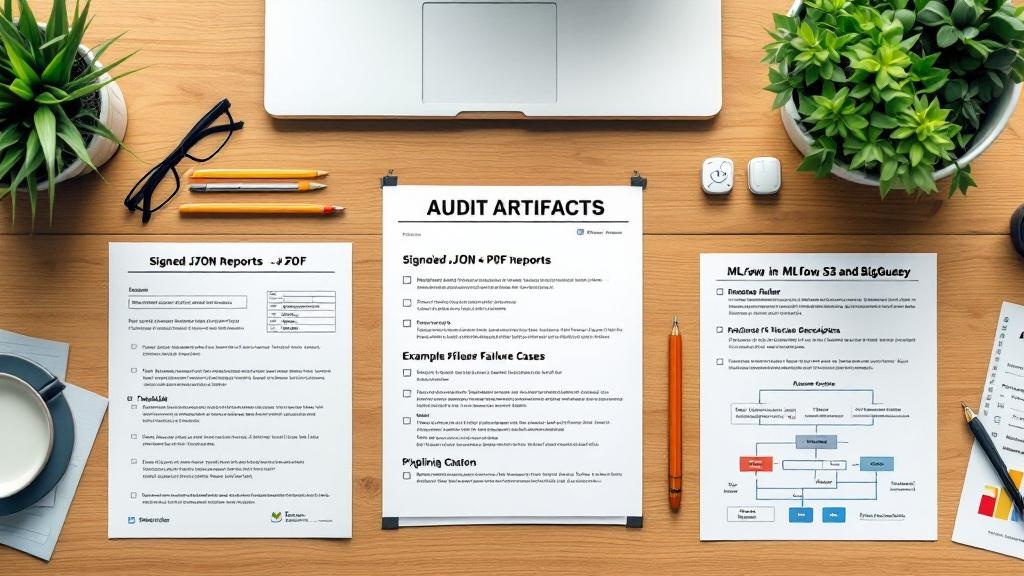
Regulators will expect a predictable set of artifacts that make audits efficient and defensible. Core items include: (1) reproducible test suites with configuration and seed values so results can be rerun; (2) signed JSON/PDF reports containing provenance metadata linking models to datasets, code commits, and environment snapshots; (3) curated failure-case examples with input, output, and explainability artifacts such as SHAP values or counterfactuals; and (4) remediation trails showing accepted fixes, ticket IDs, and subsequent test outcomes. These artifacts support both external inspection and internal audit workflows because they are machine-readable and versioned.
Practical implementation ties into existing infrastructure: connect model registries (MLflow, SageMaker, Hugging Face) and storage (S3, BigQuery) to an automated audit pipeline that emits tamper-evident artifacts. For ML teams, this is a governance and MLOps problem—automated orchestration ensures tests run per release and produce exportable evidence that satisfies regulation and audit checks. Including explicit tags like audit, compliance, and evidence in metadata makes discovery and regulatory reporting far simpler.
Practical next steps: build audit-ready pipelines and remediation trails
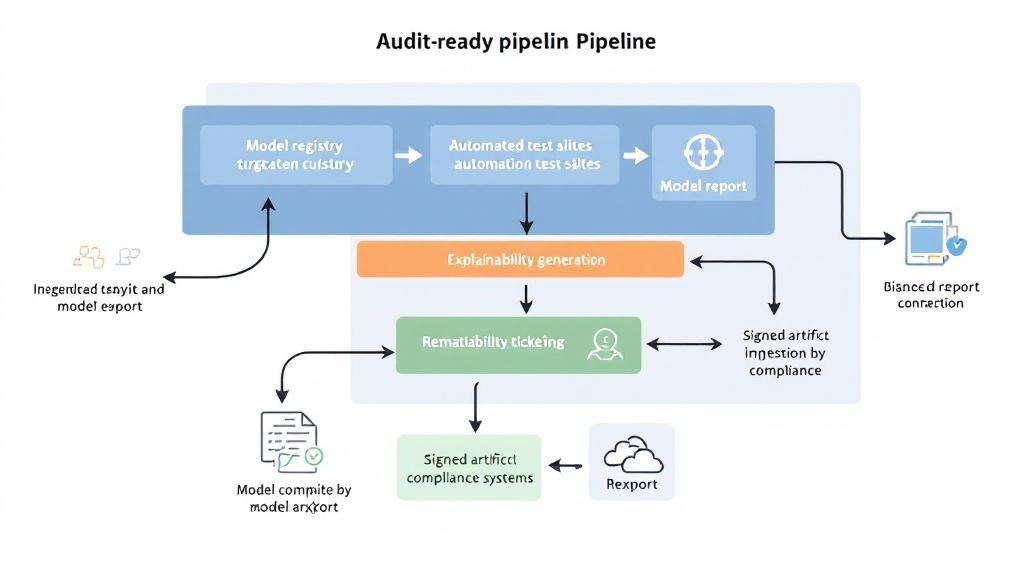
Start by instrumenting model releases with reproducible test suites and automated export of explainability artifacts. Integrate auditing with existing registries—MLflow, SageMaker, or Hugging Face—and storage backends so each model-version captures dataset hashes, commit IDs, and dependency manifests. Implement signed, versioned reports (JSON for machine consumption, PDF for human review) that include provenance, failing examples, remediation suggestions, and a signed audit trail to show tamper-evidence and accountability.
Operationalize remediation: when tests surface issues, capture remediation proposals, the engineer’s acceptance, and follow-up test runs as part of the audit record. This creates a compliance-friendly remediation trail that satisfies both internal audit and regulators. For compliance officers and governance teams, prioritize discoverability (searchable tags and metadata), reproducibility (seeded tests and environment snapshots), and exportability (standardized JSON/PDF with cryptographic signatures). These steps turn compliance from an afterthought into a repeatable, auditable practice aligned with regulation and audit expectations.